Extending Terrestrial Compute into Low Earth Orbit.
NEXCAS computing technology has been used in orbit. Our Canadian-designed platform brings solar power, radiation shielding and fault-tolerant computing together for Earth observation, AI inference and selected cloud workloads.
In-orbit system performance using NEXCAS technology
20 PFLOPS
Proposed TMR design for critical logic
3 channels
Interim aggregate constellation target
50–80 PFLOPS
Aggregate constellation target
120 PFLOPS
Which workloads belong in orbit?
Consider a satellite surveying a northern waterway. An onboard model could flag a change in ice cover and send the location and a small image crop at the next contact. A ground team could compare the finding with historical records and request the full scene where it matters.
Ground and orbit working together
Latency-sensitive services and frequently updated records stay on Earth. Batch jobs and inference on data already collected in orbit are candidates for a spacecraft. For jobs that start on Earth, the model includes the time and energy needed to upload inputs and return results.
The economics of orbital compute
For each workload, we compare the cost of completing the same job on Earth and in orbit. On the ground, we account for computing hardware, power and cooling. In orbit, we account for the compute payload, solar arrays, energy storage, heat rejection, launch, communications and useful spacecraft life. Processing imagery close to the sensor can also reduce the volume of data sent to Earth.
A Canadian foundation for sovereign compute
We are designing the platform in Canada for cloud operators and institutions that need control over where jobs run, who can authorize them and how results return to the ground.
Protecting the onboard computer
A compact AI processor can offer ample compute on a test bench. In orbit, its sustained performance also depends on how much heat the spacecraft can reject and how it responds when radiation disturbs a calculation. We design the processor, its enclosure and its recovery paths together.
The protective enclosure
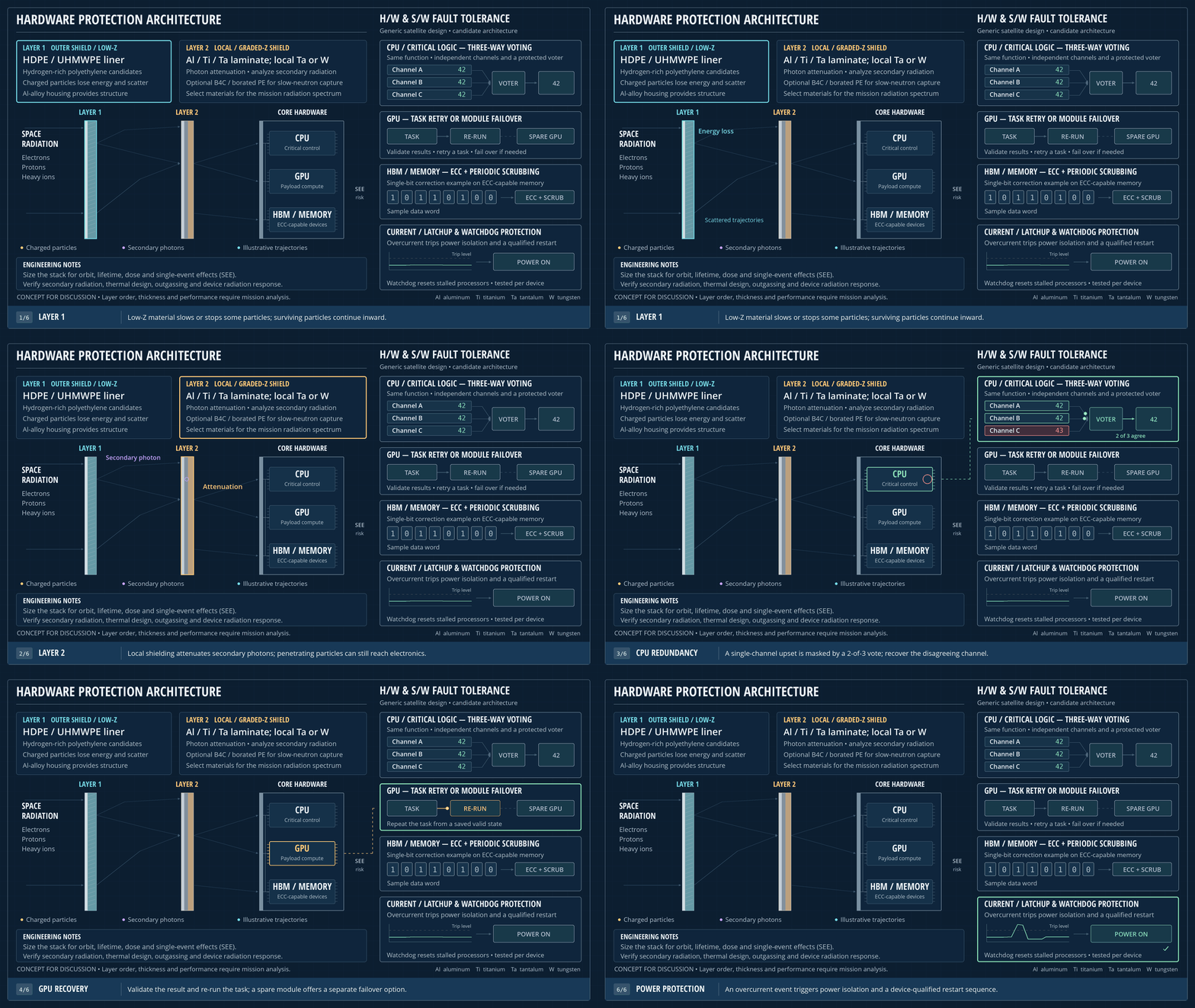
Our shielding design combines an outer layer with local shielding around sensitive components. We evaluate material composition and placement against the mission’s radiation spectrum, secondary radiation and mass budget.
Three channels for critical decisions
In our proposed triple modular redundancy (TMR) design, three independent channels perform the same critical operation. A hardware voter can use the two matching results if one channel disagrees. The voter, shared power paths and common inputs also need protection and testing.
A thermal path from chip to space
Heat travels from the processor package through a conductive interface to a radiator, which emits it into space. The layout of the CPUs and GPUs, the quality of those interfaces and the available radiator area determine how long a job can run at its intended power.
A mission-specific processor choice
The platform is designed to accommodate different CPUs and accelerators. A new processor is evaluated for power draw, heat, radiation response and software compatibility before it becomes part of a flight configuration.
Follow a particle through the two shielding layers, then see how the proposed computer handles a processor disagreement, retries a GPU task and corrects a memory error.
NEXCAS completed ground testing of its computing solution. A system using NEXCAS computing technology achieved 20 PFLOPS in orbit. Building on that experience, NEXCAS plans a phased constellation deployment, targeting 50–80 PFLOPS and ultimately 120 PFLOPS of aggregate capacity across multiple satellites. Distributing the computing load allows each spacecraft to operate within its own power and thermal limits.
Phased deployment roadmap
Phase
Capacity¹
Spacecraft design
Intended role
1 In-orbit result
20 PFLOPS
Onboard computing system using NEXCAS technology.
Technical basis for the planned constellation.
2 Expansion
50–80 PFLOPS target
Additional spacecraft, solar-array capacity and radiator area
Evaluate dedicated capacity for cloud and enterprise partners.
3 Constellation
120 PFLOPS target
Successive satellite deployments contribute to the constellation total
Integrate distributed orbital capacity into hybrid cloud operations.
¹ PFLOPS means quadrillions of floating-point operations per second. The in-orbit result is reported by NEXCAS. The two expansion figures are aggregate targets for multiple spacecraft. Application throughput depends on precision, workload and available links.
What enables each step
Payload and heat rejection
A larger spacecraft can carry more compute modules. Sustained throughput also requires enough radiator area to remove the heat those modules produce.
Solar power and storage
Larger arrays increase generating capacity in sunlight. Battery capacity and the orbit’s illumination profile determine how much computing can continue during eclipse.
Additional spacecraft
Independent jobs can be scheduled across more nodes as the constellation grows. Workloads that exchange data frequently also depend on link capacity and contact windows.
Comparing orbit with a ground cluster
For an image-analysis job, a useful comparison is how many scenes each system processes per hour at the same model accuracy, and how long it takes the customer to receive the result. Those measures give a customer a clearer basis for choosing a platform than an aggregate PFLOPS figure alone.
Orbital capacity for cloud and enterprise workloads
We welcome early design discussions with cloud infrastructure providers, AI operators and enterprise teams. Bring a representative workload. Together we can assess its compute and memory requirements, where the data originates, and when the result needs to reach a user.
Wholesale capacity for cloud and AI providers
Explore dedicated capacity blocks for scheduled inference or batch jobs. A technical briefing can cover job submission, data transfer and the measurements a cloud operator would need before committing capacity.
Isolated compute for sensitive workloads
Discuss how a dedicated execution environment could support institutional or cryptographic workloads. The design review covers who can authorize a job, how keys are managed and which ground links are permitted.
In-orbit processing of imagery and telemetry
Screen maritime imagery for a change of interest or summarize spacecraft telemetry before downlink. A ground operator could receive the finding first and request the underlying data for closer inspection.
Ready to Extend Your Compute Infrastructure Beyond the Grid?
Meet with our engineering and commercial team in Canada to review a workload, discuss the proposed architecture or explore a capacity partnership.