Isolate a hardware failure
If a processor stops or a capacitor shorts a power branch, a second processor on the same branch may also go offline. We are evaluating isolated power paths and standby hardware so the faulty branch can be disconnected.

Programs
Explore the satellite platform and the applied research project that guide our engineering work.
Engineering focus
The enclosure, power supply and processor all have a part in protecting a payload.
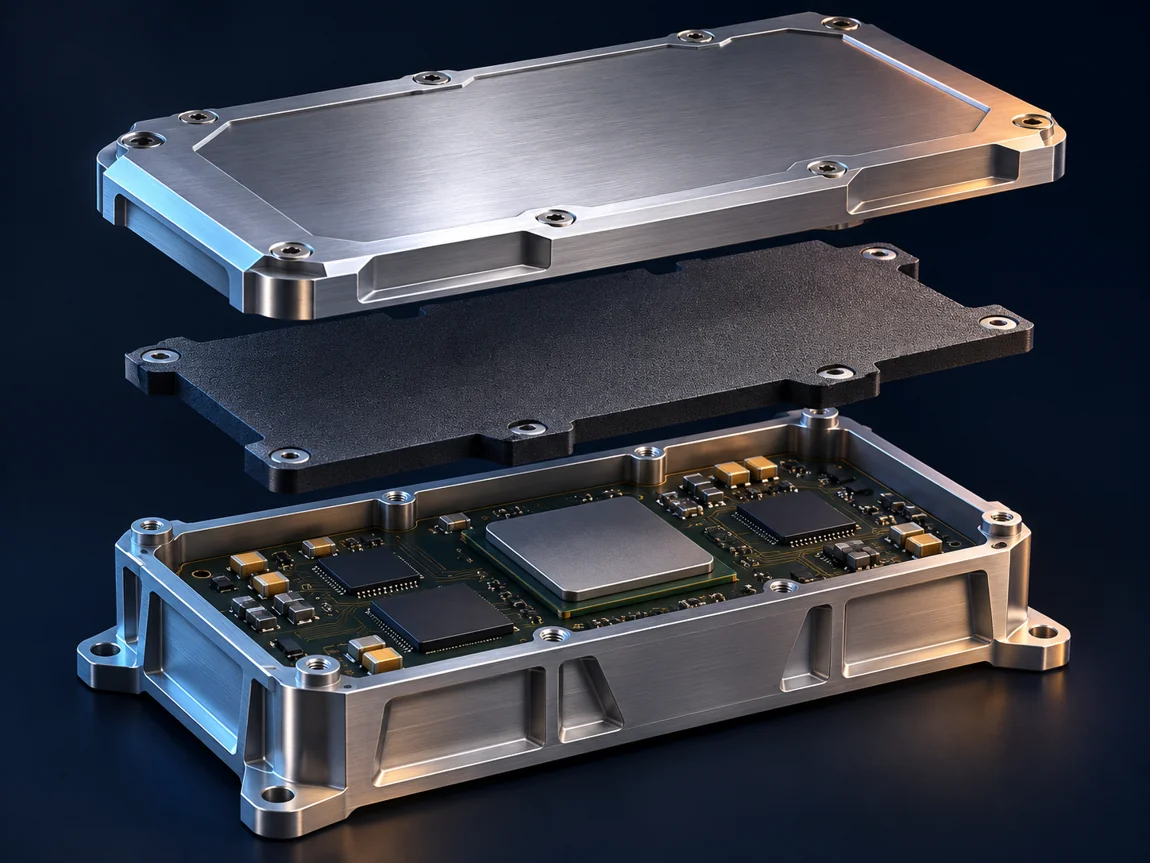
We are evaluating outer enclosure materials and inner shielding around sensitive electronics. An outer layer changes the particle field reaching the enclosure. The inner material is selected to reduce the remaining exposure at the components. Particle energy, secondary radiation and the spacecraft’s mass budget all affect that choice.
Protection also starts with the computing unit we select. We consider processing load, available power and the consequences of a fault, then tailor the board, enclosure and backup paths to the mission.
If a processor stops or a capacitor shorts a power branch, a second processor on the same branch may also go offline. We are evaluating isolated power paths and standby hardware so the faulty branch can be disconnected.
In our proposed 1×3 design, three independent channels could verify the same signed Web3 instruction. If two return the same verdict and one differs, the system could flag the outlier and use the matching pair. Without agreement, the proposed design would hold the action for review.
A majority vote can mask one independent fault. A shared power fault, a bad input or a common software error can affect several channels together. Our design approach calls for ground tests that exercise those cases.
Mission customization
Each mission begins with a question about what to observe or transmit. These are payload options we are evaluating for different mission profiles.
Antennas receive and transmit radio signals. A transponder can relay those signals between links. Coverage needs and available power guide the choice of both.
A high-resolution optical camera could map changes along a coastline. An infrared sensor could observe thermal differences. Each instrument places different demands on pointing, cooling and onboard processing.
A synthetic aperture radar (SAR) payload could observe ice or terrain through clouds and in darkness. Its power and data requirements influence the choice of computing unit and downlink.
Platform development
A platform for sensing, communications and computing in orbit.
Our computing and Earth observation programs bring together mission-specific payloads, onboard analysis and communications in a low Earth orbit platform.
The constellation design uses inter-satellite laser links in a mesh network, giving priority findings an alternate path to downlink when another route is available.

A satellite sensor collects imagery of a target area. A northern waterway, for example, can be observed over time to study changes in ice cover.
In the proposed platform, onboard processing would help identify features or changes in the imagery and select the observations most useful to a ground team.
A priority finding can travel by laser link through another connected satellite to reach an available downlink.
Applied research
An independent communications path for critical authorizations.
In the Web3 sector, digital asset exchanges and custodians rely on communications networks to authorize sensitive operations. Aegis-LEO explores whether a dedicated satellite link could carry authorization messages when an institution’s usual ground network is disrupted.
The research focuses on how institutions could approve a transfer, communicate a protective instruction or share a verified status update during an interruption. The project is at the proposal stage.